
Why Do Planes Suddenly Drop During a Flight? Understanding Turbulence and Landing Patterns
For many passengers, one of the most frightening moments during a flight is when the aircraft suddenly seems to fall. The sensation can be intense eno...
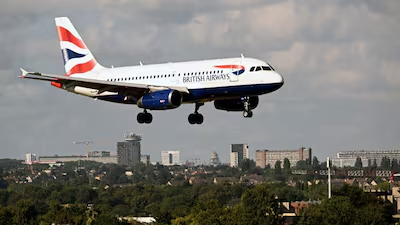
For many passengers, one of the most frightening moments during a flight is when the aircraft suddenly seems to fall. The sensation can be intense enough to make people wonder whether the plane has lost control or is heading toward a crash.
In most cases, however, a brief downward movement is associated with turbulence or changes in the surrounding airflow, rather than an aircraft suddenly losing the ability to fly.
Understanding what happens to an aircraft in the air can make these movements much less mysterious.
What causes a plane to suddenly feel like it is dropping?
Aircraft fly through air that is constantly moving. Changes in wind speed, direction and atmospheric conditions can cause an aircraft to experience turbulence.
During turbulence, the aircraft may move vertically or laterally for a short period. From inside the cabin, this can feel like the floor has suddenly disappeared beneath the passengers.
The aircraft itself may not have dropped by a dramatic distance. The sensation can be amplified because passengers have no visual reference outside the aircraft, particularly when flying through clouds or at night.
Does a sudden drop mean the plane is going to crash?
Usually, no.
Commercial aircraft are designed to withstand significant aerodynamic forces, and pilots are trained to manage changing weather and turbulence.
A brief altitude variation caused by turbulence is very different from an aircraft entering an uncontrolled descent. Modern aircraft also have systems that continuously provide pilots with information about altitude, speed, weather and other flight conditions.
The safest response for passengers during turbulence is to remain seated and keep the seat belt fastened, even when the cabin crew is not currently moving through the aircraft.
What is an “air pocket”?
The expression “air pocket” is commonly used to describe a sudden change in an aircraft's movement, but it can give the impression that the aircraft has entered an empty space in the atmosphere.
There isn't a literal hole in the air.
Instead, the aircraft may encounter a region where the surrounding airflow is moving differently. This can produce a sudden change in the aircraft's vertical motion and create the familiar stomach-dropping sensation.
Why does turbulence occur?
Turbulence can have several causes.
Weather systems
Thunderstorms and other strong weather systems can produce powerful and rapidly changing air currents. Pilots generally try to avoid severe thunderstorms because of the hazards associated with them.
Jet streams
Fast-moving bands of air at high altitude can also create areas of turbulence, particularly around boundaries where air masses with different speeds or temperatures meet.
Mountains
When strong winds pass over mountain ranges, they can generate waves and disturbed airflow that may affect aircraft flying downwind of the mountains.
Clear-air turbulence
One particularly challenging form is clear-air turbulence, which can occur without visible clouds. Because it may not be apparent from visual weather conditions, pilots rely on weather information, reports from other aircraft and forecasting systems to identify potential areas of risk.
Why do pilots sometimes fly in circles before landing?
Another situation that can worry passengers is seeing an aircraft apparently circle an airport instead of landing immediately.
This is generally part of normal air-traffic management.
When several aircraft are approaching an airport, air traffic controllers may need to sequence them so that each aircraft reaches the runway at an appropriate time. An aircraft may therefore be instructed to enter a holding pattern.
A holding pattern usually involves flying along a predetermined racetrack-shaped route while waiting for clearance to continue the approach.
Why would an aircraft need to wait?
There are several possible reasons.
Busy airport traffic: Multiple aircraft may be approaching the same runway and need to be spaced safely.
Weather: Poor visibility, thunderstorms, strong winds or other conditions can temporarily affect landing operations.
Runway availability: A runway may be temporarily occupied or unavailable, requiring arriving aircraft to wait.
Air-traffic restrictions: Controllers may need to manage aircraft arriving from different directions or coordinate movements across several routes.
Holding therefore does not automatically indicate an emergency.
Can a pilot simply land whenever they want?
No. Commercial aviation operates within a highly coordinated air-traffic system.
Pilots and air traffic controllers communicate continuously, and aircraft are given clearances and instructions regarding routes, altitudes and approaches.
Even when an airport appears quiet from a passenger's perspective, controllers may be managing aircraft that are still several miles away or operating on other runways.
Why does landing sometimes feel rough?
The final stage of a flight can involve noticeable movement because the aircraft is operating closer to the ground, where winds can vary significantly.
Crosswinds can also make an approach appear less smooth from inside the cabin. Pilots are trained to handle these conditions and use established procedures to keep the aircraft aligned with the runway.
A firm landing is not necessarily an unsafe landing. In some conditions, pilots may deliberately make a more decisive touchdown to ensure the aircraft is firmly on the runway.
What should passengers do during turbulence?
The most important precaution is simple: keep the seat belt fastened whenever seated.
Passengers should follow cabin-crew instructions and avoid walking around the cabin during periods of significant turbulence.
Objects placed on tray tables or overhead compartments can also move unexpectedly, which is why passengers are normally asked to secure loose belongings.
The bottom line
A sudden downward sensation during a flight can be frightening, but it does not automatically mean an aircraft is falling or about to crash.
Turbulence is a normal feature of the atmosphere, while holding patterns are a routine part of managing aircraft around busy airports. Pilots, air traffic controllers and aircraft systems work together to manage these conditions safely.
For passengers, the best approach is to remain calm, follow crew instructions and keep the seat belt fastened. The dramatic sensation inside the cabin can often be very different from what is actually happening to the aircraft.
Related Stories


Reader comments are moderated as per Daily News Axis editorial standards.








