Ranvir Shorey Criticises Street Protests, Urges Chief Justice to Address Disputes Through Courts
Actor Ranvir Shorey has sparked debate over the role of street demonstrations in a democracy after urging the Chief Justice of India to focus on resol...
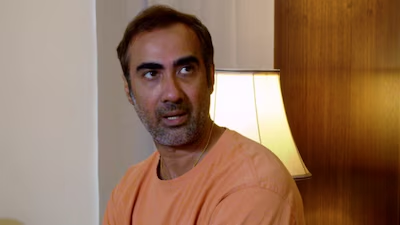
Actor Ranvir Shorey has sparked debate over the role of street demonstrations in a democracy after urging the Chief Justice of India to focus on resolving disputes through the judicial system. In his remarks, Shorey criticised the use of public spaces for political confrontation, arguing that legal institutions should remain the primary avenue for addressing contentious issues.
The actor’s comments reflect a wider discussion about the relationship between public protest, constitutional rights and the authority of the courts. His position places emphasis on judicial processes over demonstrations that, in his view, can disrupt public life and intensify political divisions.
Ranvir Shorey Questions CJP’s Protest Strategy Amid Delhi Demonstrations
Actor Ranvir Shorey weighed into the political controversy surrounding protests demanding the resignation of Chief Election Commissioner Gyanesh Kumar, calling on the movement’s supporters to pursue their demands through Parliament, elections and the courts rather than street demonstrations. His comments came as protests in Delhi entered a second day, bringing renewed attention to the dispute over electoral roll revisions.
Shorey’s Response to the Protest Call
Shorey shared his views on social media on October 11 after responding to a video featuring Sourav Das, spokesperson for the Cockroach Janta Party (CJP). In the video, Das urged supporters to continue mobilising and indicated that the movement would not abandon its demands.
The actor argued that political groups should demonstrate their support through electoral participation and parliamentary representation. He also suggested that the judiciary should be approached if activists believe other democratic channels are unfair.
Shorey’s criticism centred on the disruption that prolonged demonstrations can cause to public infrastructure and the functioning of law enforcement. His remarks have added a celebrity voice to an ongoing debate over how political movements should pursue change in a constitutional democracy.
Why the CJP Is Protesting
The CJP-led agitation is focused on the Election Commission’s Special Intensive Revision (SIR) of electoral rolls. The organisation alleges that the process has excluded legitimate voters and is demanding the resignation of Chief Election Commissioner Gyanesh Kumar.
The Election Commission and the Bharatiya Janata Party have rejected allegations of electoral manipulation. The dispute has nevertheless become a source of political tension, with protesters calling for greater scrutiny of voter-list revisions and broader electoral reforms.
Demonstrations in Delhi intensified on October 10, when CJP founder Abhijeet Dipke and other leaders, including Sourav Das and Ashutosh Ranka, were detained after arriving in the capital ahead of a planned gathering at Jantar Mantar. Numerous other demonstrators were also detained amid heightened security arrangements.
The three leaders were released on October 11, reportedly subject to conditions requiring them to maintain public peace. Dipke subsequently indicated that the movement would continue pressing its demands.
Supreme Court Intervention Over Restrictions
The protests also prompted judicial scrutiny of the restrictions imposed by authorities. Before the demonstrations, the Supreme Court had cautioned against blanket curbs on public transport, stressing that security arrangements should not impose disproportionate hardship on ordinary commuters.
During a special hearing on October 11, the court addressed concerns about detentions and disruption to essential services. It directed authorities to ensure that peaceful gatherings were not met with illegal detention and that public transport services returned to normal.
The intervention brought the balance between maintaining public order and protecting citizens’ rights to peaceful assembly into sharper focus. It also highlighted the need for authorities to respond to demonstrations without unnecessarily restricting everyday movement.
Debate Over Protest and Democratic Rights
Shorey’s comments come amid differing views on the role of street protests in political life. Supporters of demonstrations often regard public mobilisation as a way to draw attention to grievances, particularly when they believe established institutions have not adequately addressed their concerns.
Critics of disruptive protests, meanwhile, argue that political demands should be pursued through elections, legislative representation and legal proceedings.
The central dispute remains unresolved: the CJP continues to challenge the voter-list revision process, while the authorities deny wrongdoing. Shorey’s intervention has added to the public discussion, but the allegations surrounding the SIR exercise will ultimately depend on the evidence and the decisions of the institutions responsible for examining them.
Related Stories
Reader comments are moderated as per Daily News Axis editorial standards.