
Blinkit Expands Beyond Groceries as Quick Commerce Moves Into Amazon and Flipkart Territory
Blinkit is expanding its ambitions beyond rapid grocery deliveries, positioning itself as a broader online retail platform as competition intensifies ...
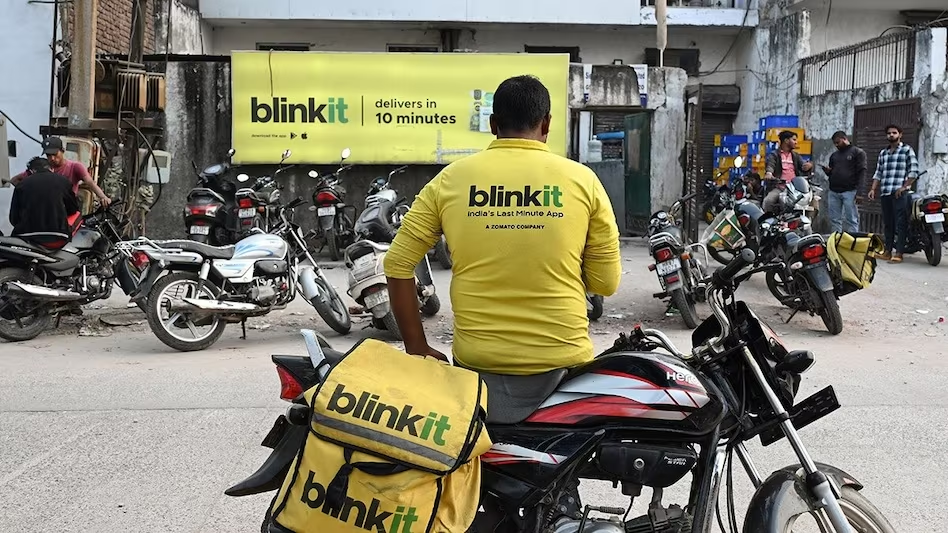
Blinkit is expanding its ambitions beyond rapid grocery deliveries, positioning itself as a broader online retail platform as competition intensifies with Amazon, Flipkart and other e-commerce players in India. Backed by substantial investment in stores, warehousing and inventory, the quick-commerce company is increasingly competing for customers shopping across multiple product categories, from beauty and electronics to household essentials.
The shift marks a significant change in India's digital retail market, where the battle is no longer limited to delivering groceries within minutes. Companies are increasingly competing on product selection, inventory availability and the ability to bring a wide range of goods closer to consumers.
Blinkit's Infrastructure Expansion Accelerates
Blinkit's parent company, Eternal, has significantly increased its investment in the business. During the first quarter of FY27, the company reported that Blinkit had become its largest consumer business, contributing 76% of consolidated adjusted revenue.
Blinkit's adjusted revenue reached ₹15,664 crore in the June quarter, representing a 552% year-on-year increase. By comparison, Eternal's food delivery business recorded adjusted revenue of ₹3,537 crore, up 33% from the corresponding period a year earlier.
However, the two businesses use different revenue models. Blinkit owns inventory and records the full value of goods sold, whereas food delivery primarily earns commissions. Net order value therefore offers another way to assess their relative scale. Blinkit's net order value rose 86% year-on-year to ₹17,132 crore during the quarter.
Its average net order value remained broadly stable at ₹518, compared with ₹521 a year earlier. This suggests that the increase in overall transaction value was driven primarily by greater ordering activity rather than a significant rise in spending per order.
The company's physical network has also expanded. Blinkit operated 2,443 stores in June 2026, compared with 1,544 a year earlier. Its estimated investment requirement per store has increased from ₹1 crore to ₹2.5 crore, reflecting the move towards larger facilities and a broader product range.
From Convenience Deliveries to Full-Scale Retail
Inventory ownership is central to Blinkit's changing strategy. In July 2025, approximately 3% of its net order value came from its own inventory. By the June 2026 quarter, that proportion had climbed to around 90%.
Greater control over inventory allows the company to expand its selection and manage product availability more directly. Its assortment now extends beyond everyday groceries into electronics, beauty products and home goods.
Blinkit has also introduced gourmet store formats in selected locations across India's eight largest cities. Its reported assortment approaches 80,000 stock-keeping units (SKUs) in Delhi-NCR, around 50,000 across the next seven cities and approximately 20,000 in other markets.
This expansion requires more capital than the traditional quick-commerce model, which relies on compact neighbourhood warehouses. Larger stores, deeper inventory and premium product categories could help Blinkit attract customers who previously relied on conventional e-commerce platforms for a wider selection.
Amazon and Flipkart Strengthen Their Quick-Commerce Push
Blinkit's expansion is unfolding as established online marketplaces increase their investments in faster delivery.
Amazon has expanded its Amazon Now service and announced more than 100 Urban Fulfilment Centres across five cities. These larger facilities offer a broader assortment, including apparel, electronics, jewellery, luggage and furniture, complementing its network of more than 1,000 micro-fulfilment centres across 100 cities.
Flipkart is pursuing a different expansion strategy through Flipkart Minutes. The service crossed 1,000 micro-fulfilment centres across 130 cities in June 2026, with a target of reaching 1,500 facilities by the end of the year. Its expansion has focused particularly on smaller cities rather than concentrating exclusively on major metropolitan markets.
Meanwhile, Swiggy Instamart and Zepto remain important competitors in quick commerce. Swiggy has placed greater emphasis on improving operating efficiency, while Zepto continues to invest in its business.
Profitability Remains a Key Challenge
Despite its rapid expansion, Blinkit still faces financial challenges. It reported adjusted EBITDA of ₹102 crore in the June quarter against net order value of ₹17,132 crore, equivalent to a margin of approximately 0.6%. Eternal has indicated that the business could eventually achieve a steady-state margin of 6%.
The difference highlights the work required to turn expanding sales and infrastructure into stronger profitability.
Blinkit's long-term opportunity lies in combining the speed of quick commerce with the product depth traditionally associated with large online marketplaces. Amazon and Flipkart, meanwhile, are adapting their established retail operations to meet demand for faster fulfilment.
As these business models increasingly overlap, India's e-commerce competition could be reshaped around a combination of delivery speed, product availability, local inventory and operating efficiency. Blinkit's next phase will depend on whether its expanding retail network can support sustainable growth while improving margins.
Related Stories


Reader comments are moderated as per Daily News Axis editorial standards.








