
Pakistan-Saudi Arabia Defence Pact Signals Deeper Military Cooperation Amid Regional Tensions
Pakistan and Saudi Arabia are strengthening their defence partnership under the strategic agreement known as the Mecca Pact, with Islamabad committing...
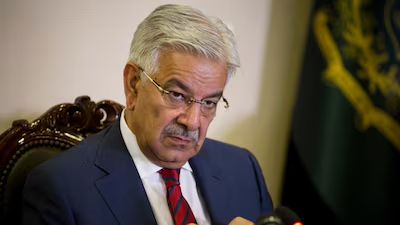
Pakistan and Saudi Arabia are strengthening their defence partnership under the strategic agreement known as the Mecca Pact, with Islamabad committing military support to the kingdom’s security. The arrangement highlights the growing importance of bilateral defence cooperation as both countries navigate an increasingly complex regional security environment.
The partnership brings together Saudi Arabia’s economic influence and strategic position in the Gulf with Pakistan’s established military capabilities. Its significance extends beyond routine defence coordination, reflecting a broader effort to strengthen security ties between two longstanding partners.
The precise operational implications of the commitment will depend on the agreement’s provisions and how the two governments interpret their responsibilities in the event of a security crisis.
A Strategic Partnership With Longstanding Roots
Pakistan and Saudi Arabia have maintained close political, economic and military relations for decades. Their cooperation has included defence training, military exchanges and security coordination, alongside financial and diplomatic engagement.
Saudi Arabia has historically relied on international partnerships to support its security, while Pakistan has maintained an important role in military cooperation with Gulf countries. The two governments have repeatedly emphasised the value of their relationship, particularly when regional instability raises concerns about national security.
The Mecca Pact adds another dimension to this relationship by placing defence commitments at the centre of bilateral strategic cooperation.
However, the practical meaning of such an agreement depends on its exact language. A commitment to assist a partner in defending its territory does not necessarily establish that every security incident would trigger an identical military response. The scope of assistance, decision-making procedures and circumstances in which support would be provided are important considerations.
Pakistan Reaffirms Its Military Commitment
Pakistan’s military leadership has made clear that its support for Saudi Arabia could involve both diplomatic and physical assistance. Lieutenant-General Ahmed Sharif Chaudhry, the military’s spokesperson, said Pakistani forces were already present in the kingdom to help protect its territory and the two holy cities of Mecca and Medina.
He also indicated that Pakistan was prepared to provide further assistance if Saudi leadership considered it necessary. However, the public statements have not specified whether additional troops would be deployed or what form any expanded military involvement might take.
Pakistan’s existing military presence in Saudi Arabia predates the latest trilateral arrangement. Cooperation between the two countries has included training, advisory support and other defence-related activities over several decades.
The distinction between an existing deployment and a new operational commitment remains important as the alliance develops its response to regional threats.
How the Mecca Pact Works
Pakistan, Saudi Arabia and Türkiye signed the Mecca Joint Defence Agreement in August 2026. A central principle of the pact is that an armed attack against one member is to be treated as an attack against all three.
The three governments moved towards implementing the agreement following a high-level meeting in Riyadh on October 5. Officials discussed regional threats and measures to improve coordination, readiness and the rapid mobilisation of military capabilities.
Türkiye’s participation gives the arrangement a broader regional dimension. Ankara has indicated that its contribution would focus on defensive support, while the precise responsibilities of each member remain dependent on the alliance’s developing arrangements.
Although the pact has been compared with collective-defence frameworks such as NATO’s, its practical operation will depend on the procedures and commitments agreed by the participating countries.
Regional Security and Diplomatic Challenges
The agreement comes amid rising instability involving Yemen’s Houthi movement and attacks affecting Saudi territory and infrastructure. These developments have increased pressure on regional governments to coordinate their security responses.
For Pakistan, the situation presents a delicate diplomatic challenge. Islamabad has strong defence ties with Riyadh but also maintains diplomatic relations with Iran. Any direct military involvement in the Yemen conflict could therefore carry wider regional implications.
Pakistani officials have also rejected speculation that Pakistani fighter aircraft are conducting cross-border strikes against the Houthis. The government has not publicly confirmed such participation.
The distinction matters because a commitment to defend Saudi Arabia does not, by itself, establish that Pakistan has entered offensive operations in Yemen.
For now, Islamabad’s position is that it remains committed to Saudi security and the collective-defence framework. The extent of any further deployment, the precise operational arrangements and the possibility of direct involvement in hostilities remain matters to be clarified by the governments concerned.
Related Stories


Reader comments are moderated as per Daily News Axis editorial standards.










