
Trump Says US Intelligence Support for Ukraine Continues as Peace Efforts Face Fresh Challenges
US President Donald Trump has denied that Washington has stopped sharing intelligence with Ukraine, saying his administration continues to assist Kyiv...
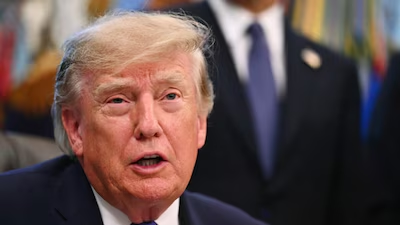
US President Donald Trump has denied that Washington has stopped sharing intelligence with Ukraine, saying his administration continues to assist Kyiv while pursuing efforts to end the war with Russia. His comments came amid renewed concerns over military coordination after Ukraine reported that it received no advance warning from international partners before a Russian missile attack on Kyiv.
Speaking to reporters on October 13, Trump said the United States remained involved in intelligence cooperation and was working with both Ukraine and Russia to find a path towards ending the conflict. His remarks sought to clarify Washington’s position at a time when questions about American support have become increasingly prominent.
The comments come against a complicated diplomatic backdrop, with the US administration pressing for an end to hostilities while disagreements persist over military assistance, attacks on energy infrastructure and relations with Moscow.
Trump Says Both Sides Need a Path to Peace
Trump said Russian President Vladimir Putin and Ukrainian President Volodymyr Zelenskyy both wanted the war to end, although he acknowledged that deep hostility between the leaders was making negotiations difficult.
The US president expressed confidence that his experience in deal-making could help move the two sides towards an agreement. However, he did not outline a detailed timetable for negotiations or identify specific concessions that either government would need to make.
The central challenge remains finding terms acceptable to both Moscow and Kyiv. Russia’s invasion of Ukraine has produced years of fighting, extensive infrastructure damage and significant civilian suffering. The two governments continue to hold sharply different positions on territory, security guarantees and the conditions required for a lasting settlement.
Trump’s latest comments indicate that his administration intends to maintain contact with both sides while trying to reduce the risk of further escalation.
Ukraine Raises Concerns Over Missing Missile Warning
The question of intelligence cooperation has taken on added urgency following a Russian missile attack on Kyiv. Ukrainian President Volodymyr Zelenskyy said Ukraine had not received the advance warning it expected from its international partners before the strike.
The reported absence of a warning raised questions because intelligence shared by the United States and other partners has played an important role in helping Ukraine prepare for Russian attacks.
However, the lack of an advance alert does not by itself establish that intelligence sharing has been suspended. Differences in the timing, availability and assessment of intelligence can affect whether warnings reach Ukrainian authorities before an attack.
Trump’s statement that Washington continues to share intelligence therefore addresses one concern, but it does not explain why the expected warning was reportedly missing in this particular case.
The incident also highlights the practical importance of intelligence coordination for a country facing continuing missile and drone attacks.
Russian Diesel Deal Adds to Washington’s Challenges
Trump also faced questions about a controversial arrangement involving Russian diesel exports. The deal has drawn criticism from lawmakers in both major US political parties, who have raised concerns about its relationship with restrictions imposed on Russian energy trade following the invasion of Ukraine.
Critics have questioned whether revenue generated through the arrangement could ultimately help finance Russia’s military campaign.
Trump defended the arrangement by arguing that the diesel was intended for the international market rather than for American consumption. He did not directly resolve concerns about whether the resulting revenue could benefit Russia’s war effort.
The issue illustrates the competing priorities facing the administration: managing global energy prices, maintaining pressure on Moscow and pursuing diplomatic efforts to stop the fighting.
What Happens Next?
The immediate questions concern whether intelligence cooperation will remain consistent, whether the reported warning gap can be explained and whether diplomatic engagement can produce meaningful progress.
Trump’s assurances suggest that the United States has not formally ended intelligence support for Ukraine. Nevertheless, the latest developments show that uncertainty over Washington’s approach continues to complicate the wider diplomatic picture.
Any lasting settlement will require more than continued communication between leaders. It will depend on concrete negotiations, agreement over security arrangements and a willingness by the parties to address the issues sustaining the conflict. For now, Washington says it is continuing to assist Ukraine while seeking a negotiated end to the war.
Related Stories


Reader comments are moderated as per Daily News Axis editorial standards.










