
Bengaluru-Based Falcon Skyworks Reports Mach 4.5 Milestone in Indigenous KAANTHAM v1 Missile Research Programme
BENGALURU, INDIA | NOVEMBER 2026: Bengaluru-based aerospace and defence technology startup Falcon Skyworks Inc. has announced a significant developmen...
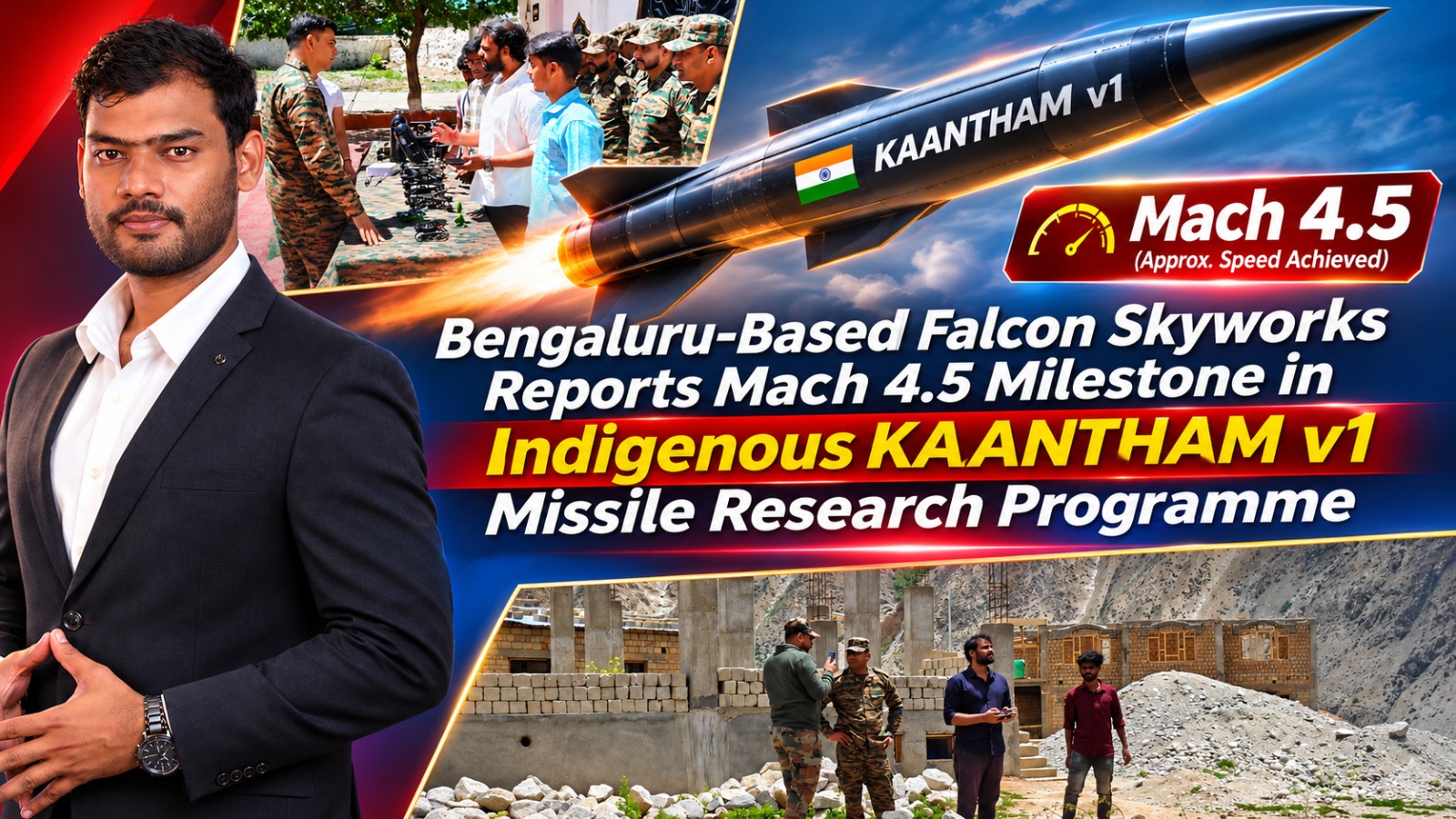
BENGALURU, INDIA | NOVEMBER 2026: Bengaluru-based aerospace and defence technology startup Falcon Skyworks Inc. has announced a significant development in its indigenous aerospace research programme, KAANTHAM v1, reporting that its lightweight missile research platform has reached speeds of approximately Mach 4.5 during internal research and testing activities.
The reported milestone marks an important development in the company's ambitions to contribute to India's emerging private defence and aerospace technology ecosystem. Under the leadership of its Founder and CEO, Aashish Prithwi Raj, Falcon Skyworks is working towards advancing indigenous capabilities across aerospace engineering, unmanned aerial systems, electronic warfare communication and high-speed propulsion research.
From Indigenous Drone Technology to Advanced Aerospace Research
Falcon Skyworks has been pursuing the development of indigenous aerospace technologies, with its earlier work spanning drone communication systems, electronic warfare communication modules, advanced UAV communication technologies and propulsion-related research.
The company credits itself with developing India's first indigenous drone transmitter, reflecting its focus on strengthening domestic technological capabilities in the unmanned aerial systems segment.
Building on its experience in communication technologies and aerospace engineering, the startup is now extending its research ambitions into advanced high-speed aerospace platforms through the KAANTHAM v1 programme.
Aashish Prithwi Raj: An Engineering-Led Vision for Indigenous Innovation
The programme is being led by Aashish Prithwi Raj, Founder and CEO of Falcon Skyworks Inc., an alumnus of the Indian Institute of Technology (Banaras Hindu University), Varanasi.
He pursued Mechanical Engineering beginning in 2016 and graduated in 2020. His academic foundation and interest in indigenous engineering solutions have played an important role in shaping the company's research-driven approach to aerospace and defence technologies.
Through Falcon Skyworks, he aims to contribute to the development of homegrown technological solutions and encourage greater participation from India's private engineering and innovation ecosystem in advanced aerospace research.
KAANTHAM v1: A New Chapter in Lightweight High-Speed Aerospace Research
KAANTHAM v1 represents Falcon Skyworks' ambition to explore a lightweight, high-speed aerospace platform supported by advanced engineering and intelligent technology integration.
According to the company, the proposed programme incorporates research into artificial intelligence capabilities, multi-platform coordination, warhead payload integration and other advanced aerospace technologies.
The name KAANTHAM, inspired by Sanskrit, symbolically represents "A Spark of Power" — reflecting the company's vision of technological innovation, engineering ambition and indigenous development.
The programme's reported Mach 4.5 milestone is an important performance claim that the company intends to evaluate further through formal testing. Any comparison with established missile systems must account for differences in platform classification, design objectives, payload, propulsion architecture and testing conditions.
February 2027: A Key Milestone for Formal Testing
Falcon Skyworks has announced plans for the formal launch and official testing of KAANTHAM v1 in February 2027.
The proposed testing phase is expected to provide a more structured assessment of the programme's engineering performance, technical reliability and development progress. It will also represent an important opportunity for the company to establish documented performance data under formal test conditions.
For an emerging Indian aerospace startup, pursuing advanced high-speed research presents substantial engineering challenges. Progress in this field requires sustained research, specialised technical expertise, rigorous validation and extensive integration across multiple engineering disciplines.
Strengthening India's Indigenous Defence Technology Ecosystem
India's defence and aerospace sector is witnessing increasing participation from private technology companies, startups and engineering innovators. This growing ecosystem is creating opportunities for indigenous research, technological collaboration and the development of specialised domestic capabilities.
Falcon Skyworks' KAANTHAM v1 programme reflects the company's intention to become part of this evolving landscape by expanding beyond its existing work in UAV communication and electronic systems.
The company's broader vision centres on contributing to India's technological self-reliance through indigenous aerospace research, engineering innovation and the development of advanced domestic technologies.
As Falcon Skyworks moves towards its planned February 2027 testing milestone, KAANTHAM v1 represents an ambitious new chapter in the company's journey.
The reported Mach 4.5 milestone, subject to formal validation, places the programme among the ambitious high-speed aerospace research initiatives being pursued by emerging Indian technology enterprises. Its forthcoming testing phase will be an important step in determining the programme's technical progress and future potential.
Falcon Skyworks Inc. continues to pursue its vision of advancing indigenous aerospace innovation and contributing to India's growing defence technology ecosystem.
“True innovation begins with the courage to envision what others consider impossible. KAANTHAM v1 represents more than a technological ambition; it embodies our belief that Indian ingenuity, determination, and engineering excellence can redefine the boundaries of aerospace innovation. Our aspiration is not merely to reach new heights, but to establish new benchmarks for generations to come.”
Related Stories

Reader comments are moderated as per Daily News Axis editorial standards.