
India’s Life Expectancy Rises as WHO Data Highlights Major Differences in Causes of Death
Life expectancy has become an important indicator of a country's overall health and development, reflecting factors ranging from medical care and nutr...
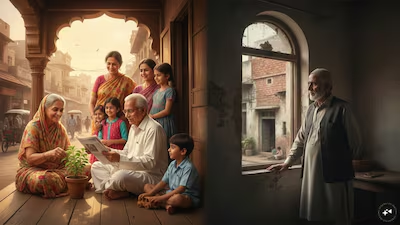
Life expectancy has become an important indicator of a country's overall health and development, reflecting factors ranging from medical care and nutrition to living conditions, education and economic opportunity.
Recent global health data highlights significant differences in expected lifespan between countries, including India and Pakistan. The figures also show how the diseases responsible for the greatest number of deaths vary considerably from one part of the world to another.
India has a higher life expectancy than Pakistan
Available World Health Organization data places India's average life expectancy above that of Pakistan.
India's life expectancy has increased considerably over the past several decades, although the country continues to face major differences between states, regions and socioeconomic groups.
Pakistan has also recorded improvements over time, but its overall figure remains lower than India's.
Life expectancy should not, however, be interpreted as a prediction of how long every individual will live. It represents an average based on mortality patterns within a population.
Why life expectancy differs between countries
A country's average lifespan is influenced by a wide range of factors.
Healthcare access is one of the most important. Countries with broader access to preventive care, vaccination, maternal healthcare, emergency treatment and medicines generally have better outcomes.
Other factors include:
- Nutrition and food security
- Clean drinking water and sanitation
- Education and awareness
- Household income
- Air pollution and environmental conditions
- Road and workplace safety
- Access to hospitals and trained medical professionals
- Prevalence of infectious and non-communicable diseases
These factors often interact with one another, making life expectancy a broad measure of population health rather than a single medical statistic.
India’s disease burden is changing
India has experienced a major shift in its pattern of disease.
In earlier decades, infectious diseases, maternal conditions and childhood illnesses accounted for a much larger share of deaths. Improvements in vaccination, sanitation, nutrition and healthcare have helped reduce many of these risks.
At the same time, non-communicable diseases have become increasingly important.
Heart disease, stroke, diabetes, cancer and chronic respiratory conditions now represent major health challenges.
This transition means that improving India's health outcomes increasingly requires both disease prevention and long-term management of chronic conditions.
Heart disease remains a major global killer
Cardiovascular diseases are among the leading causes of death worldwide.
Heart attacks and strokes are closely linked to risk factors such as high blood pressure, tobacco use, unhealthy diets, physical inactivity, obesity and diabetes.
Many of these risks can be reduced through preventive measures and early detection.
Regular medical check-ups, controlling blood pressure and blood sugar, avoiding tobacco and maintaining a physically active lifestyle can reduce the likelihood of serious cardiovascular complications.
Infectious diseases still matter in many countries
The global picture is not uniform.
While chronic diseases dominate mortality in many middle- and high-income countries, infectious diseases continue to impose a significant burden in parts of the developing world.
Tuberculosis, respiratory infections, malaria and other infectious diseases can still contribute substantially to mortality where healthcare access, sanitation and disease-control infrastructure remain limited.
This difference helps explain why countries with similar population sizes can have very different mortality patterns.
Maternal and child health remains important
Life expectancy is also closely connected to survival during childhood and pregnancy.
Deaths among infants, children and mothers can significantly reduce population-level life expectancy. Improving prenatal care, skilled birth attendance, childhood vaccination, nutrition and access to emergency medical services can therefore have a major impact.
India has made progress in several of these areas, although regional disparities remain.
The numbers tell only part of the story
Comparing India and Pakistan through a single life-expectancy figure can be useful, but it does not explain all the reasons behind the difference.
Age structure, poverty, healthcare infrastructure, education, urbanisation, nutrition and disease prevalence all influence mortality.
There can also be substantial differences within the same country. A national average may therefore hide significant gaps between different states, cities and communities.
Longer lives also create a new challenge
Increasing life expectancy is a major public-health achievement, but it also creates new demands.
As more people live into older age, healthcare systems have to deal with chronic illnesses, dementia, disability and long-term care.
The goal is therefore no longer simply to increase the number of years people live. Public-health experts increasingly focus on healthy life expectancy — the number of years people can expect to live in relatively good health.
India’s health challenge is entering a new phase
India's improvement in life expectancy represents significant progress, but the country's health priorities are changing.
The next stage will require greater emphasis on prevention, early diagnosis, affordable treatment and healthier living environments. At the same time, infectious diseases and maternal and child health cannot be neglected.
The comparison with Pakistan and other countries ultimately demonstrates a broader point: life expectancy is shaped by the combined effects of healthcare, economic conditions, public policy and everyday living conditions.
As countries continue to improve these areas, the focus is increasingly shifting from simply living longer to ensuring that people spend more of those additional years in good health.
Related Stories


Reader comments are moderated as per Daily News Axis editorial standards.