Jaishankar Outlines India’s Independent Foreign Policy as US Tariffs Complicate Bilateral Ties
NEW DELHI: External Affairs Minister S. Jaishankar has emphasised that India’s relationship with the United States must be understood as a strategic p...
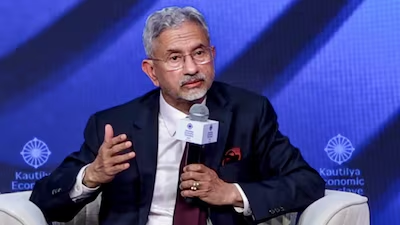
NEW DELHI: External Affairs Minister S. Jaishankar has emphasised that India’s relationship with the United States must be understood as a strategic partnership rather than a formal alliance, highlighting New Delhi’s preference for maintaining independent relationships with major global powers amid growing economic and geopolitical uncertainty.
His remarks come as India and the US continue negotiations over a proposed bilateral trade agreement, with tariffs, market access and differences over economic priorities remaining important issues. The discussions reflect a broader shift in international trade, where governments are increasingly using tariffs and industrial policies to protect domestic manufacturing and strengthen supply chains.
Jaishankar’s position underscores India’s effort to deepen cooperation with Washington without compromising its ability to pursue national interests independently.
India-US Relations Amid Trade Uncertainty
The United States remains a major economic and strategic partner for India, with cooperation spanning defence, technology, energy, investment and regional security. However, disagreements over trade policy have complicated efforts to strengthen the relationship further.
Washington’s tariff measures have placed additional pressure on negotiations, while India has sought arrangements that protect its domestic industries and improve access to the American market.
Jaishankar has indicated that trade discussions are progressing, although differences still need to be resolved before a final agreement can be concluded. The negotiations are particularly significant because the US is an important destination for Indian exports, including pharmaceuticals, engineering products, textiles and information technology-related services.
A mutually beneficial agreement could provide businesses with greater certainty and encourage investment. Conversely, prolonged uncertainty over tariffs could affect exporters' competitiveness and complicate long-term commercial planning.
Why Tariffs Matter Beyond Trade
The current tariff disputes are part of a larger transformation in global economic policy. Governments are increasingly treating trade as a strategic instrument linked to employment, industrial capacity, technology and national security.
The US has defended its approach as an effort to address trade imbalances and encourage manufacturing at home. India, meanwhile, has sought to protect sensitive sectors while expanding its role in global supply chains.
These competing priorities make negotiations more complex than a straightforward discussion about reducing import duties. Both countries must consider domestic political pressures, industrial requirements and the potential economic consequences of concessions.
For India, the challenge is to secure better access to international markets while retaining sufficient policy flexibility to support domestic production and development.
Balancing Relations With China, Russia and Europe
India’s approach to Washington also forms part of a wider foreign policy strategy involving several major powers.
Relations with China remain complicated by strategic competition and concerns about economic access. New Delhi has continued to emphasise the importance of reducing vulnerabilities and diversifying its economic relationships.
At the same time, India maintains longstanding ties with Russia, including cooperation in defence and energy. The war in Ukraine has reshaped Russia’s international relationships, making it increasingly important for India to preserve its own strategic options.
Europe represents another significant partner, particularly in trade, technology, investment and climate cooperation. Progress towards stronger economic arrangements with European countries could help India diversify export markets and reduce excessive dependence on any single economy.
This approach allows New Delhi to pursue cooperation where interests overlap without automatically aligning itself with one geopolitical bloc.
What Jaishankar’s Position Means for India
The distinction between partnership and alliance reflects India’s longstanding emphasis on strategic autonomy. Rather than accepting fixed obligations across every international issue, New Delhi seeks to assess individual questions according to its security and economic priorities.
That approach does not diminish the importance of the US relationship. Instead, it highlights the need to manage disagreements while continuing cooperation in areas of shared interest.
The future direction of India-US relations will depend partly on the outcome of trade negotiations and each country's willingness to accommodate the other's concerns. A successful agreement could strengthen economic confidence and provide a foundation for wider cooperation.
For India, the broader objective remains clear: build productive relationships with major powers while preserving the freedom to make independent decisions in an increasingly competitive international environment.
Related Stories


Reader comments are moderated as per Daily News Axis editorial standards.