Bengaluru Police Deny Permission for CJP’s Tiranga March, Cite Freedom Park Restrictions
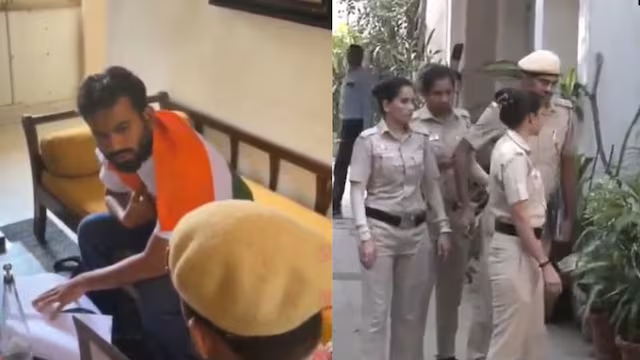
Bengaluru Police have refused permission for the Cockroach Janta Party’s (CJP) planned Tiranga March in the city, citing restrictions on public demons...
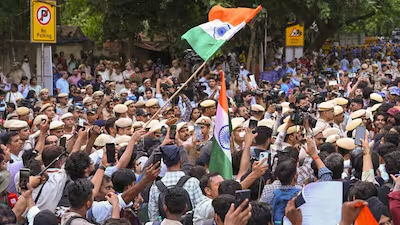
Bengaluru Police have refused permission for the Cockroach Janta Party’s (CJP) planned Tiranga March in the city, citing restrictions on public demonstrations outside designated protest locations. The march was scheduled for October 16, with organisers planning to assemble at Town Hall and proceed towards the Quit India Memorial near Mysuru Bank Circle.
The decision has brought attention to the rules governing public protests in Bengaluru, where authorities have designated Freedom Park as the permitted location for demonstrations. Organisers maintained that their proposed programme was a peaceful march intended to express solidarity with detained party members.
The event was being organised jointly by CJP and supporting groups, including Jagruta Karnataka, the All India Students’ Association’s Karnataka unit and My Vote, My Right. Organisers expected between 200 and 300 people to participate.
Why Bengaluru Police Rejected the March Permission
Police officials said Town Hall was not an authorised venue for the proposed demonstration. Their decision was based on a Karnataka High Court directive restricting protests and rallies to designated locations, with Freedom Park serving as the principal protest site.
Authorities also raised concerns about the possible impact of a gathering in the busy city centre, particularly traffic movement and public convenience.
Karnataka Chief Minister Siddaramaiah’s deputy, D K Shivakumar, said the organisers had not informed the government in advance and that Town Hall was not an approved location for demonstrations.
Rahul Jagrata, a Karnataka coordinator associated with CJP, said the organisers had submitted an intimation letter to the police but were still awaiting an official response. He described the planned event as a peaceful Tiranga March rather than a conventional protest.
The difference in characterisation highlights a central issue in the dispute: organisers presented the programme as a national-flag march, while the police treated the proposed gathering under the rules governing public demonstrations.
March Planned in Solidarity With Detained CJP Leaders
The Bengaluru programme was intended to show support for CJP co-convener Ashutosh Ranka and party spokesperson Saurav Das, who were sent to five days of judicial custody on October 14.
The two leaders had previously been detained after an incident involving a demonstration at Jantar Mantar in New Delhi, a location that had been removed from the list of authorised protest sites. They were subsequently accused of violating peace bonds they had signed after their earlier detention.
The planned Bengaluru march formed part of CJP’s broader “Lehra Do Tiranga” campaign, which sought to organise events in multiple cities. The campaign has drawn attention to questions surrounding the right to demonstrate, the use of public spaces and restrictions imposed by local authorities.
The organisers’ support for the detained leaders was therefore central to the purpose of the Bengaluru event, even as they emphasised the peaceful nature of the planned march.
Freedom Park Restrictions Draw Renewed Attention
The police decision has also revived debate over Bengaluru’s rules for public demonstrations. Under the restrictions cited by authorities, organisers are expected to hold protests at Freedom Park rather than at other prominent public locations.
Supporters of broader protest rights have questioned whether limiting demonstrations to one designated venue places unnecessary constraints on public expression. They argue that the location of a demonstration can be important when citizens seek to draw attention to a particular grievance.
Authorities, meanwhile, have relied on the need to manage crowds, reduce disruption and maintain public order in busy parts of the city.
The dispute reflects the challenge of balancing peaceful assembly with traffic management and other public responsibilities. While organisers may describe an event as a march rather than a protest, its proposed route, gathering size and location can still bring it within rules governing public assemblies.
Organisers Await Clarity on the Next Step
With permission denied for the proposed Town Hall gathering, the immediate question is whether the organisers will pursue an alternative venue or change their plans.
Freedom Park remains the designated location cited by police for demonstrations, leaving organisers with the option of considering a programme that complies with the applicable restrictions.
The episode also adds a Bengaluru chapter to CJP’s wider campaign, which has sought to organise Tiranga March events in several cities. Any further developments will depend on decisions by the organisers and the authorities responsible for approving public gatherings.
Related Stories
Reader comments are moderated as per Daily News Axis editorial standards.