
India Rejects US Court Move to Serve Summons on Ajit Doval in Pannun Case
India has strongly rejected a civil lawsuit filed by US-based Sikh separatist Gurpatwant Singh Pannun after a US federal court authorised the delivery...
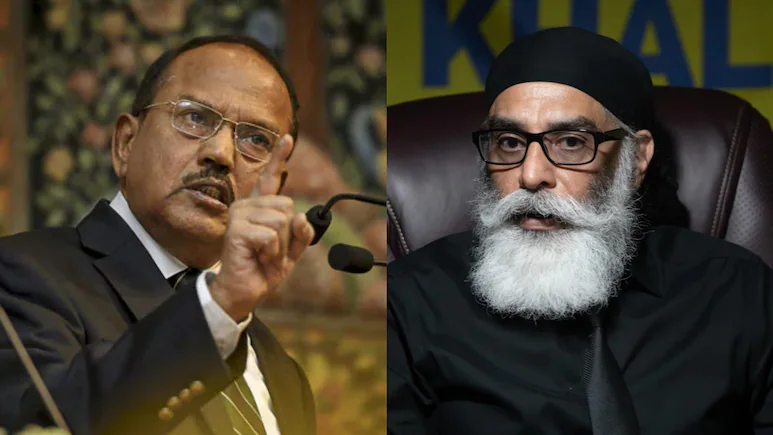
India has strongly rejected a civil lawsuit filed by US-based Sikh separatist Gurpatwant Singh Pannun after a US federal court authorised the delivery of legal summonses to National Security Adviser Ajit Doval and former Research and Analysis Wing (RAW) chief Samant Goel through courts in Delhi.
The Ministry of External Affairs (MEA) described the litigation as baseless, reiterating New Delhi’s rejection of allegations linking Indian officials to an alleged conspiracy to assassinate Pannun in New York in 2023.
The development follows an order by the US District Court for the Southern District of New York allowing the legal documents to be transmitted through three Indian district courts after an earlier attempt to serve them through India’s designated central authority was unsuccessful.
India Calls Lawsuit Baseless
Responding to questions about the latest court order on November 20, MEA spokesperson Randhir Jaiswal reiterated India’s position that the allegations lacked merit.
“We reject such baseless lawsuits,” he said, reaffirming the government’s earlier response to the proceedings.
India has consistently denied the allegations against its senior officials. New Delhi has also raised objections to the manner in which foreign legal documents should be served within Indian territory, maintaining that requests must follow the appropriate legal procedures.
The case has attracted diplomatic attention because it names senior figures associated with India’s national security and intelligence establishment. However, the latest US court order concerns the delivery of legal documents and does not establish the truth of the allegations made against them.
US Court Identifies Three Delhi Courts for Serving Legal Papers
In its November 13 order, US District Judge Katherine Polk Failla authorised an alternative procedure for delivering the summonses to Doval and Goel through the Indian judicial system.
Under the arrangement, the Patiala House District Court has been identified for Doval, while the Dwarka and Tis Hazari district courts have been designated for Goel.
The US court relied on Article 19 of the Hague Convention, which governs the international service of judicial documents, along with provisions of India’s Code of Civil Procedure.
The order directs the US court clerk to transmit the relevant documents after the plaintiff submits the required paperwork and the court approves it. The receiving Indian courts have been asked to facilitate service and provide a written record of the steps taken.
The move followed unsuccessful efforts to serve the documents through India’s designated central authority under the Hague Convention.
Importantly, authorising this procedure does not mean that the summonses have already been served. It also does not represent a judicial determination that the allegations against the defendants are true.
What Is the Pannun Civil Lawsuit About?
Pannun filed the civil lawsuit in September 2024, alleging that Indian officials were involved in a conspiracy to kill him in New York in 2023.
The defendants named in the case include the Government of India, Doval, Goel, former RAW officer Vikash Yadav, Indian national Nikhil Gupta and unidentified individuals.
Pannun, who is associated with Sikhs for Justice (SFJ), an organisation banned in India, alleges that the purported conspiracy was linked to his advocacy for an independent Sikh state called Khalistan.
India has rejected the allegations against its officials, describing the claims as fabricated and malicious. The allegations in the civil case have not been established through a judicial finding.
The lawsuit seeks legal remedies over the alleged plot, but the proceedings must follow the applicable rules governing jurisdiction, service of documents and the merits of the claims.
Civil Lawsuit Separate From US Criminal Proceedings
The civil case against the Indian government and the named officials is separate from criminal proceedings in the United States involving Gupta and Yadav over an alleged murder-for-hire conspiracy.
Gupta, who was arrested in the Czech Republic in 2023 and extradited to the United States, pleaded guilty in February 2026 to murder-for-hire and related conspiracy charges. The criminal case concerns the alleged plan targeting Pannun.
That guilty plea does not, by itself, establish the allegations against Doval, Goel or the Indian government in the separate civil lawsuit.
What Happens Next?
The immediate next step is the preparation and transmission of the documents through the designated Indian courts, subject to the US court’s approval of the required paperwork.
The case is likely to remain diplomatically sensitive because of its implications for India-US relations and the involvement of senior Indian security officials.
For India, the central issue remains its rejection of the allegations and its insistence that legal processes involving Indian officials must respect the applicable procedures. For the US court, the current stage concerns the procedural question of how the defendants can be formally notified of the civil proceedings.
The substantive allegations remain contested, and the court’s decision to permit an alternative method of service should not be interpreted as a verdict on the case.
Related Stories

Reader comments are moderated as per Daily News Axis editorial standards.